How Do They Steal Clouds? Yet Suffer from Drought!
An Anthropological Reading of Environmental Risk Interpretation
This article was written by Wissam Ibrahim Anber and was originally published on Substack on 1 May 2026. Read the original version here.
In 2025, I defended my master’s thesis, titled “Local Knowledge of Environmental Risk,” an anthropological study in Baghdad exploring how Baghdadi Iraqis understand risk and how they deal with it. At the time, I heard wild interpretations, fertile imaginations, narratives, and, of course, scientific explanations. I know it is hard to believe, but I expected the interpretations to run wilder, perhaps reaching the level of “cloud theft.” I didn’t expect the exact formulation, but I certainly anticipated bizarre notions like this.
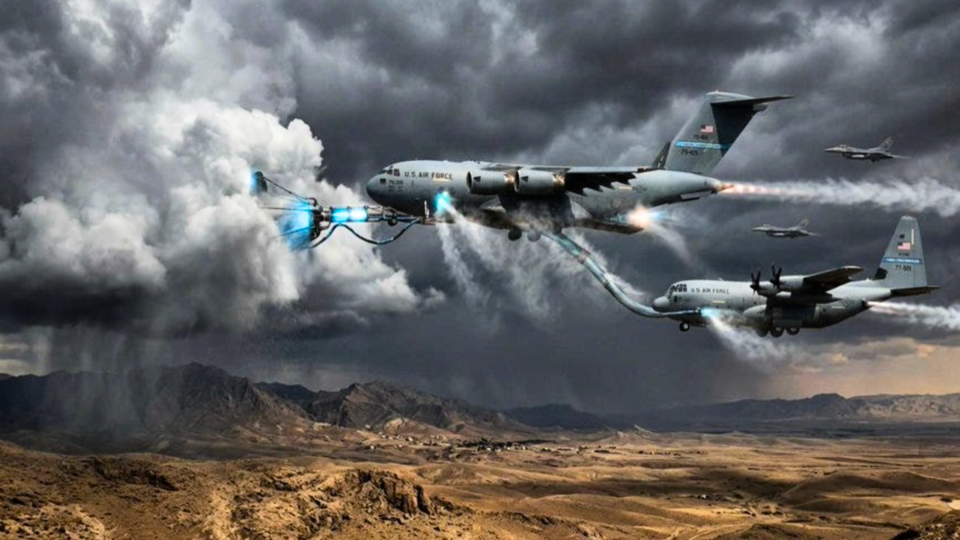
In the era of late modernity and post-conflict, Iraqi society is witnessing radical transformations in its cognitive and epistemological structure, particularly in how it deals with environmental and climatic phenomena. These transformations became clearly evident following the controversial statements made by the Iraqi Member of Parliament for the Badr Bloc, Abdullah Hamid Al-Khikani, who claimed that the United States uses special aircraft to “steal clouds” from Turkish and Iranian airspace to prevent rain from reaching Iraq. The statement went even further, offering a political and military justification for the recent heavy rainfall, attributing it to the Americans being “preoccupied with war” and tensions with Iran, which allowed the clouds to pass without interception or fragmentation. These official statements by an Iraqi legislator coincided with the widespread circulation of parallel popular rumors and narratives on social media, claiming that the Islamic Republic of Iran had bombed a “secret Israeli center in the UAE dedicated to climate control,” and that this bombing paralyzed the Israeli-American weather control system—which explains, according to the rumor, the sudden and massive increase in rainfall rates across Iraq, Iran, and Turkey.
But the anthropological paradox that puts us before a real epistemological dilemma does not lie in the issuing or denying of these statements, but in their “societal reception.” Through my fieldwork and analysis, it became clear that a wide segment of Iraqis, alarmingly concentrated among the “educated,” university graduates, and professional elites, have adopted and believed the MP’s statements and the surrounding conspiratorial narrative, completely ignoring the scientific and logical refutation issued by the Meteorological Authority.
To understand this, we must set aside the right/wrong dichotomy and look at the issue through the lens of risk perception and the structure of explanation-building.
How Did We Get Here?
For decades, Iraqis have lived through earth-shattering experiences: rifts and coups, internal and external wars, oppression, dictatorship, a suffocating blockade, an invasion, and two other wars. All local explanations for our condition since Saddam invaded Kuwait, and the aftermath, point to one thing: the external actor who overpowers us. This view took root after the comprehensive blockade; nothing goes out, and nothing comes in, as if a wall of fire had been built around us. Could anyone believe that these experiences—and the subsequent invasion and real conspiracies to destroy Iraq—would be easily forgotten? Absolutely not. This “knowledge” accumulates over the years to become part of the fabric of “folk wisdom.”
However, these “conspiratorial” explanations stem from other, more dangerous sources: the lack of trust, or the rupture with, the institutions “producing official scientific explanations”—in other words, state institutions. After long decades of mistrust, treating the authority as a danger to be avoided, an ally to external sources of risk, or at least a neutral power that does not deal with external risks (whether environmental or human), society will not engage with this authority with trust. On the contrary, it will treat most of its explanations with suspicion, which may drive it in the opposite direction to believe the other side, no matter how bizarre and illogical the alternative explanation may be. It is worth noting that the origins of these rumors regarding god-like abilities to control the weather are not primarily from Iraq, nor even from our entire region; they come from the United States itself. Theories of climate control via the HAARP project or chemtrails, among others, have been circulating in the US for years.
In his theory of the “World Risk Society,” Ulrich Beck posits an important explanation worth pausing at. He argues that we live in a “world risk society.” Late modernity, with its complex technologies and invisible risks (like climate change and radiation), has created a state of “uncertainty” that has shaken trust in “expert knowledge” and scientific institutions worldwide. The American citizen who calls the space agency (NASA) a liar regarding the climate goes through the exact same epistemological crisis as the Iraqi citizen who calls the Meteorological Authority a liar; both feel there is a monopoly on knowledge by a higher authority they do not trust. This is a product of the times we live in.
Fear of the Other, Fear of the Self
It is true that the conspiracy itself is similar, which perhaps only tells us that we are similar as human beings. But what I see, and what I have studied for over two years, is the source of the fear itself. If the environmental risk is the same, and the feeling of uncertainty is the same, what is the difference between the Iraqi and American interpretations? Clearly: the source of the risk differs in the two interpretations. The Iraqi always perceives the danger as external (Imperialism, the United States, Israel, neighboring countries), while the American mostly perceives the danger as internal (the Deep State, the New World Order, capitalist elites seeking to control citizens). True, the outcome is the same—the sense of a conspiracy—but the reasons behind each are different. The American lives clear, tangible daily experiences that undeniably suggest their government is the strongest in the world, yet it prioritizes the interests of political elites and the wealthy over their own. The Iraqi, on the other side of the world, sees that their institutions are weak and controlled by external powers; therefore, the very same powers responsible for all their tragedies must be responsible for this one too.
The mandatory question I must answer is: Why don’t the Iraqi and the American agree on the interpretation and the culprit, since this is the truth? The answer is that the agreement of both parties to blame a single entity stems from the fact that the United States represents the “supreme power” in the global imagination. In the sociology of risk, when the human mind confronts a massive, complex, and uncontrollable phenomenon (like climate change), it searches for an actor with capabilities parallel to the magnitude of the event. The United States (as the greatest technological, military, and political power in the world) becomes the sole ready candidate in the collective mind to bear responsibility for actions that seem like the work of gods. The agreement here is not on “the truth,” but on the “symbolism of the supreme power” upon which blame can be projected.
Cloud Theft or Nothing
The question that truly preoccupied me more than any other is: Why this bizarre explanation for the drought specifically? We are all accustomed, everywhere on Earth, to metaphysical explanations for environmental risks. Since the earliest forms of religion, our ancestors saw floods, droughts, earthquakes, and volcanoes as the work of wise gods who were angry and needed appeasement, or evil gods whose wrath must be avoided. In the religions we are familiar with, the matter hasn’t changed much in popular interpretations. People still see environmental risk as divine wrath resulting from our own actions.
What is different now? Why doesn’t the Iraqi say, for instance, “The cause is the mismanagement of water resources” or “This is divine wrath because of corruption”—explanations that are non-scientific yet culturally familiar or reasonable? Why the leap to “laser weapons and cloud theft”?
I have reached several answers to this question, not just one. Three answers, to be precise:
- The human mind refuses to explain immense disasters with trivial or everyday causes. The drying up of historic rivers like the Tigris and Euphrates, or unprecedented devastating floods, are “apocalyptic” events. The reasonable explanation (e.g., the accumulation of carbon emissions over decades, or the failure of local infrastructure) seems “cold and boring,” even “absurd,” and emotionally disproportionate to the scale of terror the individual experiences. A mythical disaster requires a mythical actor with the weight of a god or an equivalent power for the mind to comprehend it. Climate weapons and secret bases provide this psychological proportionality. This is known as Cognitive Proportionality.
- The second answer, simply put, is the evasion of responsibility. If the social actor adopts a reasonable explanation, such as climate change due to human consumption, or the failure of local governments they elected or accepted, this places them in the circle of responsibility or obligates them to act and change. The wild conspiratorial explanation is an excellent defense mechanism. It completely shifts the problem into the realm of an “overwhelming superpower” that neither the simple citizen nor their government can confront. The fictional conspiracy absolves society from a sense of failure, placing it in the category of the “absolute victim.”
- The third answer is the rationalization of chaos and the false sense of control. In a risk society, the idea that climate change is blind natural chaos, and that the planet is altering in ways that might spiral out of control, is a terrifying and existentially anxiety-inducing thought. The human mind prefers to believe that a secret, evil entity is managing this chaos from a control room, rather than believing no one is behind the steering wheel and the planet is careening toward disaster randomly. The conspiracy, despite its horror, returns the universe to a managed and understandable state, even if the manager is evil.
All these answers may be correct; they are not mutually exclusive. But what caught my attention is that they all lead to the same conclusion, or a fourth explanation: oppressed societies, whether the individual is Iraqi or American—or at least a large segment of them—view the global government and the sole world power as the gods of the modern era. Why would anyone think the governments of the US and Israel have the ability to control the weather? Wasn’t this once the exclusive domain of the gods? The psychological need of oppressed societies for an “absolute power” that controls this material universe has not disappeared; rather, it has been projected onto the “superpower” (the US/Israel). The oppressed social actor has clothed these states in attributes once ascribed to the gods: the absolute power to destroy nations, overthrow regimes, and now, change the climate; absolute knowledge, total surveillance, satellites, and advanced espionage that sees everything.
As science fiction writer Arthur C. Clarke said: “Any sufficiently advanced technology is indistinguishable from magic.” For societies suffering from a massive technological and civilizational gap, or even for marginalized classes within Western countries themselves, the capabilities of the American military-industrial complex seem like magical or divine powers. If this power can guide a drone from space to strike a moving target with centimeter precision, what prevents it, in the popular imagination, from “gathering clouds” or “directing hurricanes”? High technology here transforms in the collective mind into a new “metaphysics.”
Furthermore, for oppressed peoples, viewing the hegemonic power as a “modern god” is an urgent psychological need to justify repeated defeats and absolute helplessness. If the United States were merely a state with economic and military superiority, this would mean that defeating, resisting, or even catching up to it is theoretically possible, and failing to do so is a local failure and a personal shortcoming. But if this power is akin to a “god” that controls clouds, earthquakes, and rain, then helplessness before it becomes an inevitable fate for which the oppressed cannot be blamed. The “deification” of the colonizer or the hegemon is the highest degree of psychological surrender, for it shifts the conflict from a human-human conflict (which is possible) to a human-divine conflict (which is impossible).
I must admit that, despite my specialization in the subject, my preoccupation with it over this period arose from my bewilderment and astonishment at the human capacity to resist the obvious. I asked myself repeatedly: How can an educated person believe that America, whose own Midwest and Far West suffer from drought causing catastrophic wildfires, possesses the ability to transport clouds? This was my attempt to answer myself before anyone else, avoiding complexities and theories that might be of no use to anyone.
Wissam Ibrahim Anbar
Anthropologist
w.i.anber@proton.me