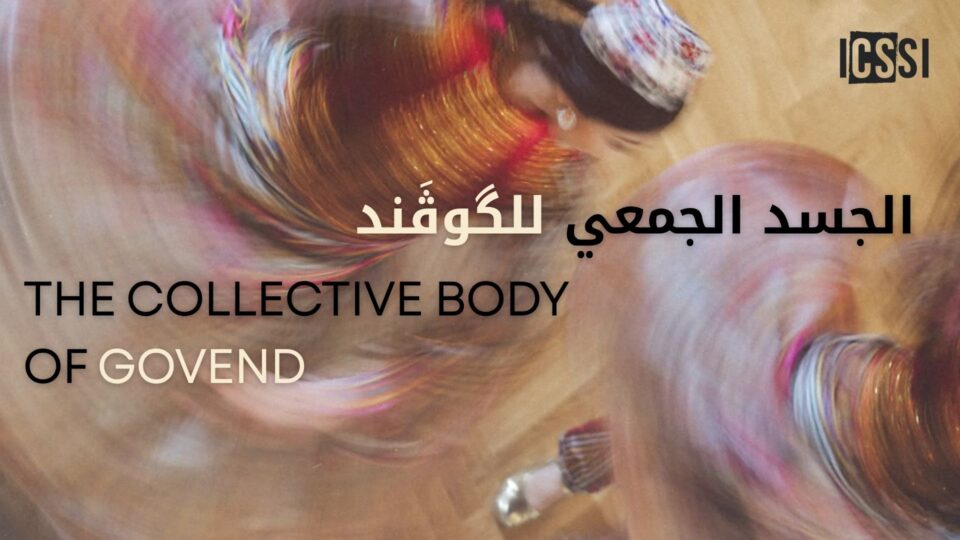
The collective body of govend: Kurdish dance, belonging, and resistance
In many contexts, dancing is associated with celebration, festivity, and the intimacy of a community coming together. But there are also histories in which dance is something more: a political language, a form of cultural continuity, a gesture that resists the dispersal of memory. In the Kurdish case, this is especially true of govend, the collective line or circle dance performed at weddings, celebrations, seasonal festivals, and public gatherings. To reduce it to mere folklore would mean missing its deeper significance. In many Kurdish contexts, dance is not only a cultural expression: it is also a way of asserting presence, preserving history, and resisting erasure.
Govend is an ancient and widespread practice across the different regions of Kurdistan and among Kurdish diaspora communities. Rather than being a single, rigidly codified dance, govend is a family of forms: it varies from region to region, as do its rhythms, steps, and the occasions on which it is performed. What remains constant, however, is its choral and collective nature: dancers hold hands, follow a shared rhythm, and move forward and backward together, turning movement into a collective gesture before it is an individual one. It is precisely this long historical and territorial layering that makes it reductive to read govend as mere entertainment. Govend emerged and is transmitted as a shared social practice, embedded in community life: it did not originate as a staged performance, but as a lived dance, created within the community and for the community.
- The body that remembers: form, rhythm, and embodied memory in govend
The strength of govend lies, first and foremost, in relationship, and that relationship already takes shape in its choreographic structure. Its most recognizable configuration is a line or semicircle, with participants standing side by side. They hold one another by the hands, by the fingers, or through small handkerchiefs or light grips that preserve contact without stiffening the movement. The group moves forward, steps back, sways laterally, and follows the rhythm with small jumps, foot beats, and variations that may change according to region, music, and occasion. In some contexts, the step is more energetic and festive; in others, more composed, almost ceremonial. What remains constant, however, is the dance’s choral character. Govend does not place individual virtuosity at the center: its power comes from the fact that bodies hold one another, synchronize and entrust themselves to a shared tempo.
The figure of the leader also plays an important role, not only in practical terms but symbolically as well. It is often he or she who modulates the rhythm, emphasizes certain gestures, and gives energy to the line, sometimes while holding a handkerchief. Yet this guidance does not turn the group into a passive mass. On the contrary, every dancer must remain attentive, present, and attuned to the others. Govend requires both discipline and participation, mutual listening and the ability to remain within a common rhythm without entirely losing one’s singularity. In this sense, the dance stages an ordered but living collectivity: not an undifferentiated whole, but a community that is built in movement, through the coordination of bodies and the continuity of gesture.
It is precisely here that govend exceeds the idea of a simple performance to be watched. It is not a dance designed for an external and passive gaze, but a form of presence sustained by connection. Bodies arrange themselves beside one another, support one another, produce a common rhythm, and in doing so make a continuity visible. In contexts marked by repression, assimilation, or diaspora, where social bonds may be broken or weakened, this kind of collective dance also becomes a way of rebuilding community in space and time. People do not simply dance together: they remember together, occupy space together, and renew a form of belonging together. From this perspective, Sara Islán Fernández reads govend as a commemorative practice capable of keeping alive a sense of belonging within a Kurdish community shaped by transition, displacement, and the transformation of its social spaces. Dance, then, does not merely accompany memory: it enacts it.
The reference to Diana Taylor helps clarify even further the kind of memory at stake here. Taylor distinguishes between archive and repertoire: the former preserves through documents, texts, records, and stable materials; the latter through the body, gesture, repetition, and performance. This distinction is particularly fruitful in the case of govend, because it allows us to think of dance not as an ornament of social life, but as a genuine form of cultural transmission. Not everything a collectivity experiences enters the official archive; not everything is recognized or fixed in documents. And yet much can continue to survive in the repertoire of bodies: in rhythms that are repeated, in hands that clasp one another, in steps learned without manuals, in memory that passes from one generation to the next precisely through the shared repetition of gesture.
Seen in this light, govend preserves an embodied memory. Bodies remember what often does not appear in archives: losses, displacements, repression, but also the capacity of a collectivity to remain alive. The memory transmitted through dance is neither linear nor purely narrative; it does not settle into an ordered chronology, but manifests itself as presence. For this reason, govend can be read, with Taylor, as part of an embodied repertoire: it does not document in the institutional sense of the term, but it transmits; it does not produce a text, yet it makes continuity visible. And perhaps it is precisely here that its deepest symbolic meaning emerges: in govend, the community is not simply represented, but takes bodily form, gathers itself, recognizes itself, and renews itself in the shared time of dance.
2. Cultural pride and Kurdish visibility
It is precisely here that govend escapes the reassuring category of “cultural heritage” understood in a neutral sense. In the Kurdish world, culture has not always been an innocent terrain. Language, music, dance, clothing, festivals, and even place names have, in different state contexts, been subject to marginalization, prohibition, assimilation, or renaming. For this reason, in the Kurdish context, pride in one’s cultural heritage does not simply coincide with attachment to the past: it often takes on the character of a historical claim. Dancing govend, singing in Kurdish, publicly celebrating Newroz, or wearing traditional clothing means reaffirming that Kurdish culture is not a folkloric residue to be tolerated at the margins, but a living, autonomous presence worthy of recognition.
The contribution published in Kurdistan Chronicle, in presenting govend as an identity-based and cultural gesture rooted in Kurdish social life, can also be read in this light: not as a simple ethnographic description, but as testimony to a practice that continues to produce community. Dance, then, does not merely preserve the past. It makes it visible in the present and transforms it into a form of collective expression. From this perspective, govend is not the decorative reflection of an already given identity, but one of the sites in which that identity takes shape, renews itself, and appears publicly.
There is, in all of this, a decisive question: visibility. A culture does not exist in the public sphere only because it is named, but also because it is practiced, embodied, and made perceptible. Govend produces precisely this effect. It transforms belonging into a shared gesture. It makes the body a site of cultural display. Where an identity has often been forced to negotiate its right to appear, a collective dance can become a concrete mode of public presence. It is not only a matter of preserving something that already exists, but of reaffirming it in the very moment in which it is enacted. For this reason, govend is not only memory: it is also manifestation, in the fullest sense of the word.
3. When dancing becomes a form of resistance
This political density emerges with particular force when dance is monitored, obstructed, or criminalized. In such cases, the meaning of the gesture goes far beyond the festive moment itself. To target a dance is to send a broader message: certain forms of Kurdish visibility are tolerable only as long as they remain depoliticized, folklorized, or confined to the private sphere. When govend, by contrast, appears in public space as a collective gesture of belonging, it may be treated as excessive, suspicious, even subversive. Repression, then, does not strike only individual people, but the very right of a community to express itself publicly through its own culture. In this sense, the Medya News report on the criminalization of Kurdish dance and the August 2024 statement by Human Rights Watch on cases in which Kurdish songs and dances were treated as “terrorist propaganda” show with particular clarity how culture can become a direct terrain of surveillance and punishment.
It is here that Benjamin Bilgen’s reading becomes especially useful. Bilgen interprets Kurdish group dance in Turkey as a negotiated yet concrete practice of cultural resistance, capable of opposing the domination of Kurdish cultural identity, the Kurdish body, and the sociocultural autonomy of Kurdish space. The point, from this perspective, is not simply that the dance “represents” an identity, but that it makes that identity operative in space. A line of bodies moving in unison does not communicate only harmony or festivity: it produces a visible “we,” coordinates bodies into a shared form, and transforms gesture into political presence.
This reading helps explain why a dance may be perceived as threatening precisely in contexts where Kurdish cultural expression is subject to control. Govend, then, is not only a traditional dance, but a tangible form of cultural resistance. Collective dance produces a visible “we.” And every “we” that takes shape in a space marked by denial or assimilation carries political potential, even when it does not present itself in the classical languages of protest: it makes visible what elsewhere has been pushed toward silence.
4. Beyond trauma: govend as a practice of collective existence
To read govend only in terms of opposition would be reductive. Its strength lies not only in resisting against something, but also in generating an affirmative space. Dancing together does not simply mean opposing cultural annihilation; it also means producing joy, continuity, beauty, and relation. This point is essential, because minority cultures are too often narrated exclusively through the register of trauma. In govend, by contrast, memory and vitality coexist. The dance carries the weight of history, but it is not exhausted by it. It is at once commemoration and renewal, wound and persistence, mourning and celebration.
Precisely because it is a group dance, govend lends itself in a particular way to this double reading, both affirmative and political. An individual dance may express emotion, skill, or style; govend, by contrast, stages a coordinated community. In its very form, it is already a small politics of the body. There is reciprocity, because movement depends on the relationship among participants; there is visibility, because the group presents itself as a collective body; there is transmission, because the steps are learned more through participation than through study; there is continuity across generations, because the dance remains alive in the very act of being repeated, reaffirming belonging not as an abstract idea but as a concrete and shared experience. To look at it from this perspective means recognizing that cultural resistance does not take place only in grand national narratives or in openly insurgent moments. It also takes place in the folds of everyday life, in seemingly ordinary practices, in gestures that persist. A line of bodies moving in unison can say, without proclaiming it, that a community is still there; that it continues to remember; that it continues to name itself; that it continues to generate forms of belonging despite everything.
Perhaps this is the most important lesson that govend offers to those who look at it closely: culture is not the aesthetic residue of a politics that happened elsewhere. It is one of the places where the political is produced, sedimented, and transformed. And dance, far from being a mere ornament of collective life, can become one of its densest forms. Not only because it represents an identity, but because it enacts it. Not only because it remembers a past, but because it makes that past active in the present. Not only because it survives, but because, each time it is repeated, it reaffirms the right of a collectivity to remain visible.
References
- Bilgen, Benjamin.Kurdish Group Dance as Resistance in Turkey. Major Research Paper, York University, 2018.
- Islán Fernández, Sara. “The Commemorative Power of Govend Dances for a Kurdish Community in Transition.” the world of music (new series) 11, no. 2 (2022). Göttingen, Germany: Göttingen University Press.
- Sinclair-Webb, Emma. “Türkiye: Kurdish Songs and Dances Are Not Terrorist Propaganda.” Human Rights Watch, August 15, 2024.
- K.Chronicle. “Dance and Culture: The Roots of Govend.” Kurdistan Chronicle, July 8, 2024.
- Glynn, Sarah. “Dancing the Resistance to Cultural Annihilation – a Weekly News Review.” Medya News, August 3, 2024.
- Taylor, Diana.The Archive and the Repertoire: Performing Cultural Memory in the Americas. Durham, NC: Duke University Press, 2003.