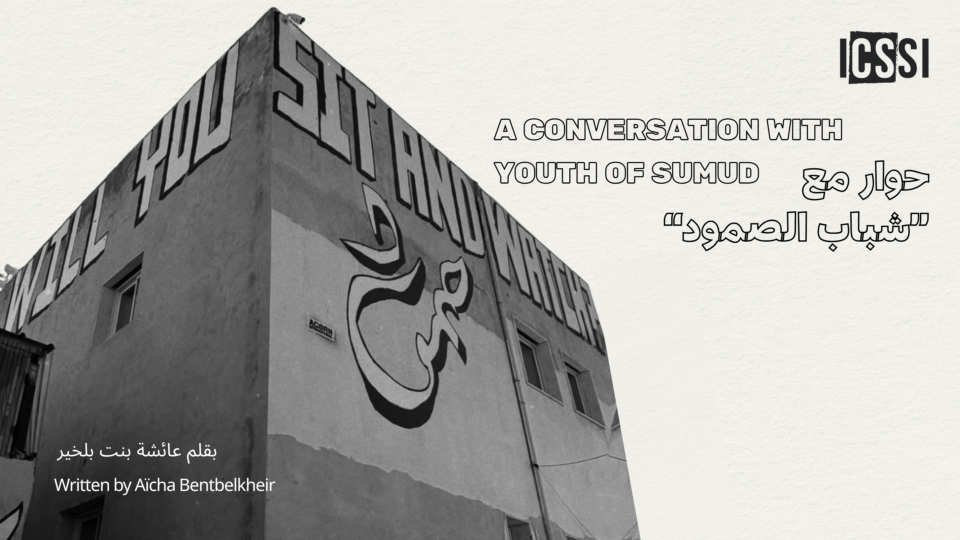
A Conversation with Youth of Sumud in Masafer Yatta: Activism, Daily Life, and the Death Penalty Law
Written by Aïcha Bentbelkheir
In Masafer Yatta and its surrounding villages in the South Hebron Hills, a group of young activists known as “Youth of Sumud”, which literally means “Youth of resilience”, is working to maintain a presence in Palestinian lands in Area C of the West Bank where Palestinians have to live under full Israeli control. These territories are deeply affected by settler violence and forced displacement. A few days ago, I spoke with one member of this organization which built its movement in nonviolent resistance.
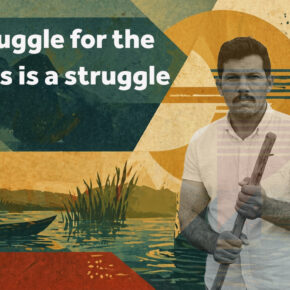
Adeeb Huraini, 26, is a Palestinian activist from the village of Tawani in Palestine. He is a member of the Youth of Sumud, a grassroots movement that is based in South Hebron hills that aims to “be in the frontlines resisting Israeli violence and indigenous erasure.”[1] With a background in international law, Adeeb combines legal understanding with on-the-ground activism in a highly sensitive and changing context. During our conversation, he described the daily realities faced by communities in these villages. We also discussed the latest proposed death penalty law which could further harden their living conditions. While not yet fully implemented, its potential impact is already being felt, particularly by activists whose work may become even more exposed to risk. This local reality draws an important context for understanding how the law is perceived on the ground.
Youth of Sumud was founded on May 19, 2017, when a group of young Palestinians decided to return to the village of Sarura which was about to be confiscated by settlers. Adeeb recalls the beginning of the movement: “we started with simple steps with strong determination” he says, while listing its goals: reclaiming the land; establishing a permanent presence to prevent further confiscations; and rebuilding homes to “recreate life in the village”. The organization has rooted its approach in nonviolent resistance and what they describe as “protection by presence”. In practice, this means accompanying shepherds as they graze their livestock near settlements, staying with families at risk, and escorting children on their way to school as they often have to cross areas where settler violence is frequent. Since 2017, Youth of Sumud grew and has expanded its activities across several communities in Area C of the West Bank.
In Masafer Yatta, the presence of Youth of Sumud is critical, and Adeeb recalls what happened in the village of Khalet Ad-Dabi’ where mass demolitions at one point left families without any shelter. Temporary shelters such as caves or caravans were constantly targeted by settlers or even demolished sometimes. During that critical and violent time, activists from Youth of Sumud decided to stay alongside the community, encouraging families to remain in the village despite increasing pressure. This encouragement often translates into providing food and other forms of support. Youth of Sumud also coordinates international activists who come to “protect” inhabitants simply by being there. Later, a court decision eventually ordered settlers to leave the area, which marked a big victory for the organization. In addition to this “protection by presence,” Youth of Sumud also engages in advocacy beyond the West Bank and works in collaboration with Israeli activists, including lawyers, to apply pressure on Israeli courts which sometimes lead to small but significant victories.
However, Youth of Sumud is currently operating in a very hostile environment. “The situation has completely changed since October 2023” Adeeb says. He describes a tough reality marked by increased violence, including night and day raids, constant physical and verbal attacks, shootings, and growing cases where homes, land and livestock have been set on fire. In this context, every aspect of daily life for the inhabitants of these villages is painted with insecurity.
At one point during our interview, I was astonished by the level of dehumanization Palestinians are subjected to. “Settlers do not differentiate between men and women nor elderly and non-elderly nor between adults and children not even babies” he says while recounting an attack that occurred last year at night, during which more than 20 people were injured. Among them was a two-month-old baby who was sprayed with pepper spray in her eyes. That night, two elderly were also brutally assaulted.
In such context, the death penalty law is not an abstract legal development but part of a broader oppressive apartheid system that could further shape the risks of everyday life. After being debated several times in the Knesset following the October 7 war, the law has once again taken center stage and gained renewed momentum. Although it has not yet been fully implemented, human rights organizations are ringing all the alarm bells to trigger a transnational pressure to prevent its adoption. The law would allow courts to impose death penalty in certain cases, particularly those framed as “acts of terrorism”. Critics warn that it risks reinforcing the system to which Palestinians are already subjected.
According to Human Rights Watch, the law is “discriminatory” and would be “primarly if not exclusively, be applied to Palestinians”[2]. In addition to concerns over fair trial guarantees, the law would be part of a broader apartheid system that is governing Palestinians. Currently, Palestinians are subjected to military law, while Israelis fall under civilian law. In practice this creates a situation where in the same territory two separate systems are operating: Palestinians are tried to military court with stricter procedures and less legal protection while Israelis are tried in civilian courts and benefit from greater legal rights. In addition to that, an alarming large number of Palestinians are held in Israeli prisons (around 9200[3]) and many in inhumane conditions with nearly half of them under administrative detention without charge or trial with no access to legal defense[4]. In this context, B’Tselem also documents “unprecedented and extreme violence” targeting Palestinians since October 2023 in both the West Bank and Gaza its report “Our genocide”. [5]
For Adeeb, this legal development is a continuation of what he already observes on the ground. He emphasizes that it would give carte blanche to settlers and legitimize the impunity they already enjoy. He also argues that “the aim of this law is to be applied to Palestinians only” as it deepens an already existing system of persecution and adds another layer of psychological pressure. And to illustrate what such law could mean in practice, he evokes the situation of prisoners in detention: “I can only imagine the prisoner who has been imprisoned for so many years, waiting for the day of freedom, but instead finding a rope tied around his neck.”. Through this scene he is describing, he highlights the level of fear and uncertainty such a law could introduce.
When asked about the impact on activists on the ground, Adeeb does not hesitate: “this law will change everything for activists and for all Palestinians”. In practice, he explains how it could allow settlers to justify violence more easily claiming self-defense even when no real threat exists. “A settler can just claim that he felt in danger” he adds, pointing to a system in which Palestinian voices are often, if not always, dismissed. As a result, activists like him fear being increasingly exposed to arbitrary violence that could cost them their lives. In this sense, the law risks becoming an additional tool that would lead to a further escalation of violence. For Adeeb, these risks are not abstract since they will be part of their everyday life. Beyond the increase in direct violence, Adeeb explains that “to be an Arab means you are not allowed to live”, pointing at a continuous sense of vulnerability since the law would be applied within an already highly restrictive reality where basic services like electricity, water, healthcare, and access to work which would help to a semblant of stability are increasingly difficult to obtain nor maintain.
Since October 2023, Adeeb explains that access to work has become nearly impossible for Palestinians. Even those who manage to find work face dangerous risks, including incarceration while crossing the border to the “1948 lands” as he describes, meaning Israel. In such situation, they may be exposed to violence from settlers while simply going to work. Adeeb shares the tragic story of Yusri Abu Qbeta who was brutally shot by a settler in his vehicle while driving which eventually led to his death, unfortunately such incidents are not isolated. In this context, the law clearly appears as an additional tool of oppression that reinforces an environment where safety is never guaranteed.
When asked if he wanted to share a message with the reader, Adeeb stepped back from the legal and political dimensions and decided to share the following with the reader: “In conclusion, we are not only speaking about a law or a group of young people, but about a lived reality. From Khirbet Sarura, where we strive to bring life back to a displaced land, to laws that threaten human life, one truth remains: dignity and justice are not optional – they are a right. At Youth of Sumud, we believe that resilience is not just about survival, but about defending life, rights, and the future. Despite all challenges, we will remain committed to our land, our humanity, and our belief that justice will prevail.”
His words reflect a broader reality in which, despite increasing violence, sustaining life itself and presence becomes a form of resistance.
[2] Huma Rights Watch (2026) “Israel: Discriminatory Death Penalty Bill Passes”
[3] Office of the United Nations High Commissioner for Human Rights (2026). Report of the Special Rapporteur on the situation of human rights in the Palestinian territories occupied since 1967 (A/HRC/61/71). United Nations.
[4] B’Tselem (2026, January). Living hell: The Israeli prison system as a network of torture camps
[5] B’Tselem. (2025, July). Our genocide.